
You have decided to restore your hair. Now comes the harder question. Should you pick FUE or FUT? Clinics often push one method, and online forums add more noise than clarity.
This guide compares both methods in plain language. You will see how each one works, where each one wins, and who should choose which. If you are an NRI or an international patient, you will also find tips for planning treatment in India. For a wider overview, our complete hair transplant in India guide covers the full journey.
FUE vs FUT: The Real Difference
Both methods move hair from the back and sides of your scalp to thinning areas. These donor hairs resist the hormone that causes pattern baldness. That is why transplanted hair usually lasts.
The only real difference is how the surgeon collects the donor hair.
- FUE (Follicular Unit Extraction): the surgeon removes follicles one by one with a tiny punch tool.
- FUT (Follicular Unit Transplantation): the surgeon removes a thin strip of scalp, closes the wound, and splits the strip into grafts under a microscope.
After collection, both methods place the grafts the same way. So the hairline design and the final look depend mostly on surgeon skill, not on the harvesting method.
How FUE Works
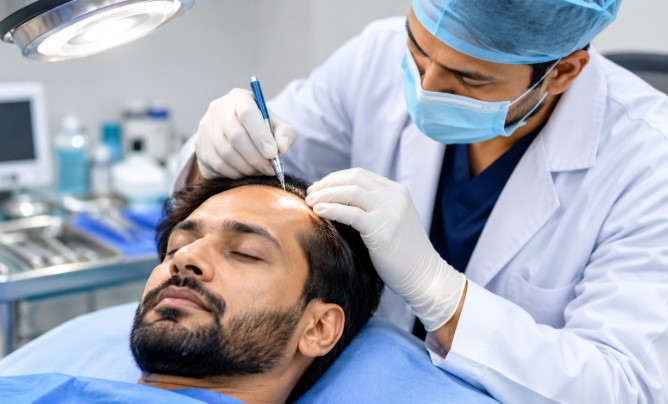
In FUE, the donor area is usually trimmed or shaved. The surgeon then extracts each graft with a punch of under 1 mm. No strip is cut and no stitches are needed in the donor area.
Where FUE does well
- Leaves tiny dot-like marks instead of one long line
- Easier early healing and less donor-area tightness
- Lets you wear very short hair with less worry
- Works for beard, eyebrow and body-hair harvesting
- Helps when scalp skin is too tight for a strip
Where FUE has limits
- Takes longer, so large sessions may be split over two days
- Needs a bigger shaved or trimmed donor zone
- Can damage grafts if the surgeon lacks skill
- Over-harvesting can leave the donor area looking thin
Reviews of both techniques note that FUE leaves scattered, easy-to-hide scars. A peer-reviewed comparison on PubMed also states that some patient groups suit FUE, some suit FUT, and some suit both.
How FUT Works
In FUT, the surgeon removes a narrow strip from the back of the scalp. The wound is stitched shut. Technicians then cut the strip into single grafts of one to four hairs.
Where FUT does well
- Can give a high number of intact grafts in one session
- Often costs less per graft
- No need to shave the full donor area
- Lower risk of graft damage during harvesting
Where FUT has limits
- Leaves a linear scar, which may show under very short hair
- Needs stitches, with a tighter and sorer donor area early on
- Depends on scalp looseness, so some people cannot have it
- Repeat strip surgeries get harder over time
The International Society of Hair Restoration Surgery has published clinical practice guidelines for FUT. They stress careful patient selection, including your skin elasticity and your future hair-loss risk.
FUE vs FUT at a Glance
| Factor | FUE | FUT |
|---|---|---|
| Donor collection | One graft at a time | Single scalp strip |
| Scar | Small dot scars | One fine linear scar |
| Stitches | Usually none | Yes, in donor area |
| Best for short hair | Yes | Less suitable |
| Grafts in one session | Moderate to high | Often higher |
| Session length | Longer | Shorter harvesting |
| Early donor discomfort | Usually lighter | Usually more tightness |
| Typical cost in India* | ₹25–₹45 per graft | ₹20–₹35 per graft |
*Indicative ranges only. Your final quote depends on graft count, surgeon and clinic.
Scars and Hairstyle: The Deciding Factor for Many
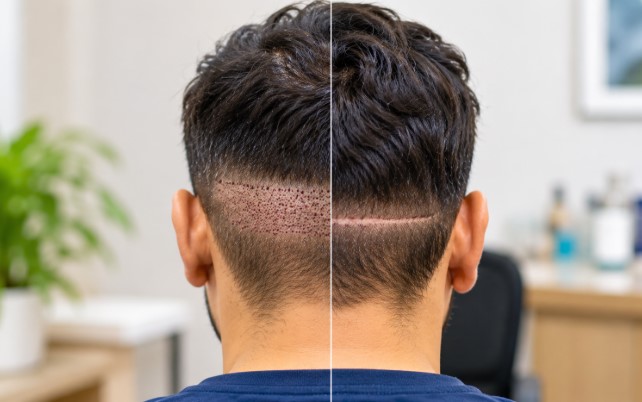
Ask yourself one question first. How short will you ever wear your hair?
If you like a buzz cut or a shaved look, FUE is usually the safer choice. Tiny dots blend into short stubble. A strip scar can show as a thin pale line. With longer hair, both scars stay hidden.
Also think about the future. Hair loss can progress, and styles change. Choose the method that keeps your options open.
Graft Count and Donor Hair
Your donor area is limited. It is like a bank account. Every graft you take is a withdrawal, so a good surgeon plans for the long term.
FUT can bring out many grafts from one strip. FUE can match that, but it spreads extraction over a wider area. If you have advanced baldness, your surgeon may suggest a mix. Some people have FUT first and FUE later for extra grafts. Others use body hair when scalp donors run low.
A graft count that sounds too big for your donor density is a red flag. Honest clinics recommend what your scalp can safely give.
Recovery and Downtime
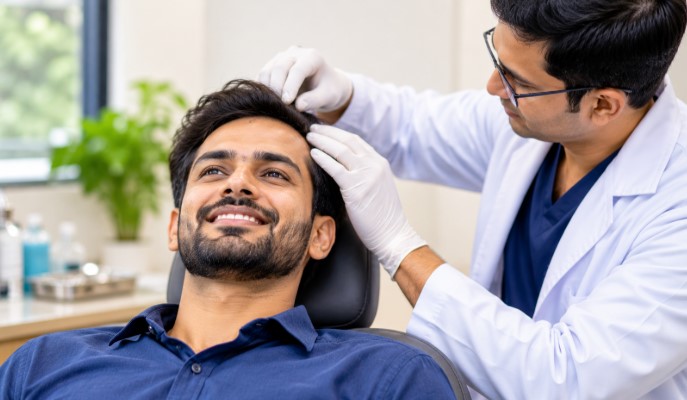
Most people return to desk work within three to five days after either method. The donor area feels different, though.
- FUE: small scabs in the donor area fade within about a week.
- FUT: stitches or staples usually come out after roughly ten to fourteen days, and the area may feel tight.
- Both: transplanted hair sheds in weeks two to four, then regrows. Expect visible results from month six and full results around month twelve.
Not sure which recovery plan fits your work and travel dates?
Cost of FUE vs FUT in India
Hair transplant costs in India are often far lower than quotes in the US, UK or Australia. FUT usually costs a little less per graft. FUE costs more because it takes longer and needs more technician time.
Price is only one part of the picture. A cheap quote with weak planning can cost more later in repair work. Ask for a written estimate that lists graft count, extra sessions, medicines, PRP and follow-up visits. Our treatment planning and cost estimate service helps you line these items up side by side.
DHI vs FUE: Where Does DHI Fit?
Many patients think DHI is a third rival to FUE and FUT. It is not that simple.
FUE and FUT describe how donor hair is collected. DHI describes how grafts are placed. In DHI, the surgeon loads each graft into a pen-like implanter and places it directly, without pre-cutting channels. The grafts usually come from FUE extraction.
So the real DHI vs FUE question is about implantation. DHI may offer fine control over angle and depth, which can help in hairlines and small zones. It can also take longer and cost more, as our guide shows with higher per-graft ranges of ₹40–₹70. Standard FUE with sapphire or steel blades can still deliver natural results in skilled hands.
Do not choose a method by its brand name. Choose the surgeon who explains why a method fits your scalp.
Which Hair Transplant Is Best for You?

There is no single winner. The best method is the one that matches your hair loss, donor area and lifestyle.
FUE may suit you if you:
- Prefer short hair or may shave your head
- Want to avoid a linear scar
- Need beard or body-hair grafts
- Have a tight scalp
- Need a smaller to medium graft count
FUT may suit you if you:
- Have advanced hair loss and need many grafts at once
- Keep your hair longer and can hide a thin scar
- Have a loose scalp and strong donor density
- Want to avoid shaving a large donor area
- Prefer a lower cost per graft
Pause and rethink if you:
- Are very young and your hair loss pattern is still changing
- Have diffuse thinning with no stable donor zone
- Have an untreated scalp condition or health issue
- Expect teenage density to return
If you are in the last group, a scalp check and medical hair-loss treatment may come first. The American Academy of Dermatology explains that results depend on the cause of hair loss and a proper evaluation.
Planning a Hair Transplant From Abroad

Overseas patients should treat this as a medical decision, not a holiday package. Start remotely, then travel once you feel clear.
- Send clear scalp photos for a first review
- Book a pre-travel teleconsultation to discuss method and graft count
- Get a second medical opinion if two clinics suggest different methods
- Plan four to six days in India, including a check-up
- Check visa steps early with our travel and visa assistance page
Healthcare in India varies a lot by city and clinic. DeshSansaar explains how treatment works in India for overseas families, including family involvement and why calm, written estimates matter. It also lists common scam red flags for NRIs, which is useful when a clinic pushes you to pay a large advance.
Aftercare matters too. Keep your scalp clean and follow your surgeon’s washing plan. Once your surgeon approves, gentle herbal care can sit alongside medical advice. Many readers explore Advik Ayurveda’s herbal hair-care range and these Ayurvedic scalp-care habits for daily routines. These products do not replace a transplant or prescribed treatment, and you should avoid anything new on the graft area until your surgeon says it is safe.
Ready to shortlist surgeons?
Risks and Realistic Expectations
Both methods are safe in trained hands, but no surgery is risk-free. Possible issues include swelling, itching, temporary numbness, infection and uneven growth. Poor graft handling can lower survival, whichever method you pick.
Shock loss is also common. Some transplanted and nearby hairs fall out around the first month. This is normal, and new growth follows. Do not judge your result before month six.
Last, remember that a transplant cannot stop hair loss in untouched areas. Your surgeon may suggest medicines to protect existing hair. Plan for that from day one.
Judge the Surgeon, Not Only the Method
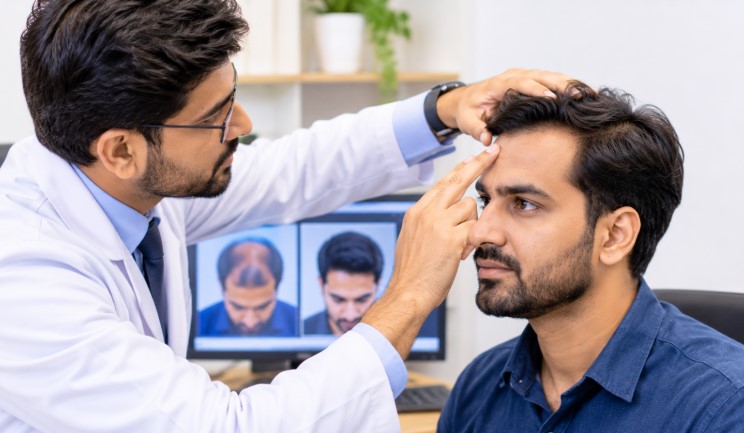
Studies and guidelines agree on one point. Patient selection and surgeon skill shape the outcome as much as the technique does.
- Check that a qualified dermatologist or plastic surgeon leads the plan
- Look at before and after photos of patients with hair like yours
- Make sure the surgeon, not only technicians, designs the hairline
- Be careful with clinics that promise guaranteed density
- Prefer clinics that offer both FUE and FUT, so advice stays unbiased
A clinic that sells only one method may steer you toward it. A clinic that offers both can tell you honestly which one suits you.
Want to see who offers both methods?
Questions to Ask Before You Choose
- Why do you recommend this method for my scalp?
- Who performs extraction and who places the grafts?
- How many grafts can my donor area safely give?
- What is the plan if I need a second session?
- What is included in the quote, and what is extra?
- Can I see results from patients with my hair type?
Conclusion
FUE gives small, hidden marks and more styling freedom. FUT gives many grafts in one go at a lower cost, with a linear scar. Neither is better for everyone. Match the method to your hair loss, your donor area and your hairstyle.
Want a personal view of both methods?
FAQs:
Not always. FUE suits short hairstyles; FUT suits large graft needs and lower cost.
Yes, a thin linear scar. Longer hair usually hides it well.
Transplanted hair usually lasts, though untreated native hair may keep thinning.
No. DHI is an implantation technique, usually done with FUE-extracted grafts.
FUT is usually cheaper per graft, but total price depends on grafts and clinic.
Most international patients plan four to six days, including a follow-up check.
Comments