
When you are picking a hospital outside your own country, one question matters more than glossy photos or star ratings: who actually checked this place, and against what rulebook? For patients flying into India from the US, UK, Canada, Australia, or the Gulf, and for NRI families coordinating care for parents back home, hospital accreditation is the closest thing to an independent safety check you get before you ever meet a doctor.
India runs two accreditation systems side by side: the India-based NABH standard and the international JCI standard. Neither is a logo hospitals add for decoration. Both require years of documentation, unannounced audits, and repeat inspections to keep. This guide explains what each accreditation actually verifies, how many Indian hospitals hold them, and how you can check a hospital’s status yourself before you commit to a flight, a surgery date, or a large upfront payment.
Why Accreditation Should Be Your First Filter, Not an Afterthought
Most people researching treatment abroad start with cost comparisons or reviews on social media. Accreditation usually gets checked last, if at all. That order should be reversed. A hospital’s accreditation status tells you whether an independent body has already reviewed its infection control, staffing ratios, equipment maintenance, and emergency response — things you cannot judge from a website photo or a five-star testimonial.
Once you know a hospital is properly accredited, comparing specialists across departments like cardiac care, oncology treatment, or orthopaedic surgery becomes a much safer exercise, because you are choosing between vetted options rather than gambling on an unknown. Treat accreditation as your first filter, then narrow down by specialty and budget from there.
Ready to compare vetted options?
See Our Accredited Partner Hospitals and start with a shortlist that has already been screened.
What Hospital Accreditation Actually Means
Accreditation is not a hospital saying it is good. It is an outside organisation auditing the hospital against a written set of standards, then returning periodically to check nothing has slipped. Assessors review patient files, interview staff, walk through operating theatres, and test emergency protocols. A hospital that fails key measures does not get the certificate, or loses it at renewal time. This is very different from a hospital simply listing its equipment or doctor qualifications on its own website. In India, two systems carry real weight: NABH, the domestic standard, and JCI, the international one.
NABH: India’s National Benchmark
The National Accreditation Board for Hospitals and Healthcare Providers, known as NABH, was formed in 2005 as a constituent board of the Quality Council of India, which operates under the Ministry of Commerce and Industry. NABH assesses hospitals against more than 600 parameters split between patient-centred standards, such as consent processes and pain management, and operational standards, such as drug storage and infection surveillance.
A hospital seeking NABH accreditation has to build a process-driven system covering everything from registration and admission through pre-surgery, surgery, and discharge follow-up. Re-assessment happens roughly every two years, so the certificate is not a one-time achievement. NABH’s own standards are accredited by ISQua, the international body that accredits accreditors, which is why NABH is generally treated as being on par with leading global hospital accreditation systems rather than a lesser, India-only version. NABH also certifies blood centres, dental providers, eye care organisations, and Ayurveda and Panchakarma clinics under its separate AYUSH accreditation stream, which is worth knowing if your trip combines modern treatment with traditional care.
JCI: The International Gold Standard
Joint Commission International, or JCI, is the global arm of the Joint Commission, the same body that accredits the majority of hospitals in the United States. That link is part of why JCI accreditation carries particular weight with American patients and their insurers. JCI evaluates hospitals against more than 1,000 measurable elements grouped under patient safety goals, quality management, and staff qualifications, and it currently accredits healthcare organisations across more than 100 countries.
India now has over 50 JCI-accredited hospitals, a number that keeps growing as more private hospital groups pursue international recognition to attract patients from North America, the UK, and the Gulf. Unlike NABH, JCI accreditation is entirely optional and self-funded by the hospital, which is one reason it tends to cluster around larger private hospitals in metro cities rather than spreading evenly across the country. If a hospital lists JCI accreditation, it has chosen to be measured against the same framework used to evaluate hospitals in the US, UK, and other high-income countries.
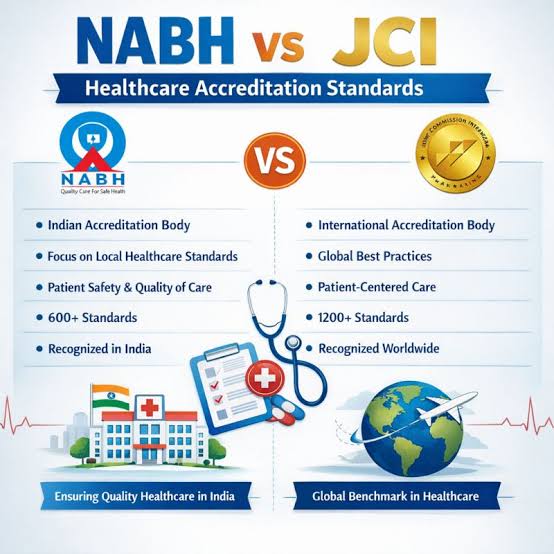
NABH vs JCI: How They Differ, and Why Both Can Matter
NABH and JCI are not competitors and they check different things for different audiences. NABH has far greater reach inside India, with more than 29,000 healthcare facilities accredited or certified across hospitals, clinics, laboratories, and AYUSH institutions, making it the backbone of quality regulation for Indian healthcare generally. JCI is narrower and more selective, aimed at hospitals that actively court international patients and want a credential instantly recognisable abroad.
A hospital holding both signals two things at once: it meets India’s domestic quality bar, and it has been separately tested against a framework built for global comparison. When you are choosing a hospital as a foreigner or NRI, dual accreditation is a strong, though not the only, signal worth weighing.
What Assessors Actually Check Inside a Hospital

Accreditation is not a paperwork exercise. Assessors physically walk through the hospital and test whether written protocols hold up in practice. Four areas matter most for a patient travelling from abroad.
Patient Safety Systems
Assessors look at how a hospital identifies patients correctly before procedures, how it manages medication errors, and how staff respond to a deteriorating patient in the middle of the night, not just during a scheduled inspection. Written protocols mean little if staff cannot demonstrate them on the spot, which is why assessments include direct interviews and simulated scenarios, not just a review of files.
Infection Control and Hygiene
Sterilisation logs, hand hygiene compliance, and how a hospital isolates infectious patients all get reviewed. For a patient flying in for surgery, this is one of the most consequential checks, since post-operative infection is one of the biggest risks in any invasive procedure, wherever it happens in the world.
Staff Credentialing and Training
Accreditation confirms that every doctor, nurse, and technician on staff has verified qualifications on file, and that ongoing training is tracked rather than assumed. This matters especially for international patients who cannot personally verify a surgeon’s degree or a nurse’s certification the way they might through a trusted local referral back home.
Post-Discharge and Follow-Up Protocols
Good accreditation standards do not stop at the operating theatre door. They also examine how a hospital manages discharge instructions, medication reconciliation, and follow-up communication once a patient has left the building, or in your case, once you have flown home. This is directly relevant when you are also trying to figure out how to prepare for surgery abroad and how much recovery time to build into your travel plan.
Why Accreditation Matters More When You’re Treating From Abroad
If something feels off at a local hospital back home, you likely have a friend who is a nurse, a family doctor to call, or years of local reputation to lean on. None of that exists when you land in an unfamiliar city for treatment. You cannot walk the ward the week before booking, and you often cannot fully judge reviews written in a language or context you don’t know well.
Accreditation fills that gap. It is an independent, repeatable check that does not depend on you knowing anyone locally. For NRIs coordinating care for aging parents in India from another country, this matters even more, since decisions are frequently made over a phone call with no chance to visit the facility first. It helps to understand how Indian healthcare actually works on the ground beyond the certificate on the wall, especially if you are managing a parent’s treatment long-distance.
Need a second set of eyes on a diagnosis before you decide anything?
Our Second Medical Opinion service connects you with specialists who review reports remotely.
How to Verify a Hospital’s Accreditation Yourself
Do not take a hospital’s word for its own certification. Both NABH and JCI maintain official directories where you can check a hospital’s name, accreditation status, and validity dates directly, bypassing whatever the hospital’s marketing page claims. Ask the hospital’s international patient desk for their accreditation certificate number and cross-check it against the accrediting body’s own listing.
Because NABH accreditation is renewed roughly every two years and JCI on a similar cycle, a hospital that was accredited three years ago and never mentions a renewal date is worth a direct question. This step takes about fifteen minutes and can save you from a costly mistake. It is also worth testing how a hospital’s pre-travel teleconsultation team handles this kind of question, since a facility confident in its accreditation is usually quick to share documentation rather than deflect.
Accreditation Is Necessary, But It Isn’t the Whole Story
A certificate on the wall tells you a hospital’s internal systems have been checked. It does not arrange your visa, translate your discharge summary, or tell you which specialist within an accredited hospital has the strongest outcomes for your specific condition. That layer of planning sits outside what any accreditation body reviews.
This is where a structured patient support process, covering treatment planning and cost estimates through to travel and visa assistance, becomes as important as the hospital’s certification itself. An accredited hospital with poor coordination around your arrival can still turn into a stressful trip. Accreditation should be your baseline requirement, not your only requirement, when you are building a treatment plan around a flight.
Once you know what to look for, the easiest next step is to browse hospitals already screened for you.
See Our Accredited Partner Hospitals and shortlist the ones that fit your treatment and budget.
Red Flags Worth Pausing On
A few warning signs are worth taking seriously before you commit to any hospital abroad:
- The hospital cannot produce a specific accreditation certificate number when asked directly.
- You are pressured to pay a large deposit before any doctor has reviewed your reports.
- Cost estimates keep changing verbally, with no written breakdown.
- Staff cannot answer basic questions about infection rates or complication protocols.
- You are discouraged from getting a second opinion before agreeing to a procedure.
None of these automatically mean fraud, but together they suggest a facility, or the agent representing it, is more interested in closing a booking than in your safety. If you are unsure how to separate a genuine facilitator from an opportunistic one, it helps to read up on common scams and red flags NRIs and foreign patients encounter when arranging treatment in India, since the same patterns repeat across cities and specialities.
Recovery Matters As Much As the Procedure Itself
Patients planning surgery abroad tend to focus heavily on the operation date and forget the weeks that follow. Skin healing after cosmetic or dermatology procedures, in particular, needs gentle, consistent care once you are back in your hotel room or home country, away from the hospital’s nursing staff.
Many patients recovering from dermatology, hair, or minor cosmetic treatments in India prefer to pair hospital-grade aftercare with simple, natural skincare that will not irritate healing skin. If you want product-level guidance on gentle, toxin-free formulations suited to post-procedure skin, Advik Ayurveda’s natural skincare range is a useful reference point worth exploring alongside your hospital’s own discharge instructions.
Want help mapping your recovery timeline before you book flights?
Get a Treatment Planning and Cost Estimate and build your trip around a realistic healing window.
Bringing It Together
Accreditation will not make every decision for you, but it removes the biggest unknown: whether a hospital’s basic systems have been independently checked. NABH tells you a hospital meets India’s domestic quality bar. JCI tells you it has also been measured against a global framework used to compare hospitals across countries. Neither replaces your own homework on cost, specialist experience, and how well a hospital communicates before you arrive. Use accreditation as your starting filter, verify it directly rather than trusting a webpage, and build the rest of your plan, including recovery, on top of that foundation.
FAQs:
India’s national hospital quality certification, run under the Quality Council of India.
Not better, just different scope: JCI is global, NABH is India’s domestic standard.
More than 50, and the number keeps growing every year.
Yes. Check the official NABH or JCI directory before you book.
No, it confirms safety systems, not individual surgical results.
NABH-accredited hospitals are typically reassessed roughly every two years.
Comments
[…] guide on hospital accreditation standards for international patients explains what these accreditation labels actually mean in practice, so you can shortlist a hospital […]
[…] bodies such as NABH, and to read up on documents you’ll need for treatment in India and how accredited Indian hospitals are for international patients so nothing catches you off guard after you […]
[…] accreditation before you fly. MorningSun’s guide on how accredited Indian hospitals are for international patients is a good starting point for the allopathic […]